
 Facebook
 X
 Pinterest
 Copy Link
Florida Amendment 3 | St. Johns County Real Estate Update
If you own a home in St. Johns County, a second home near the coast, or an investment property, there’s an important distinction to understand before the November 3 election.
Is your property classified as homestead or non-homestead?
The answer could make a significant difference in how Florida’s proposed Amendment 3 affects your property taxes.
Direct Answer
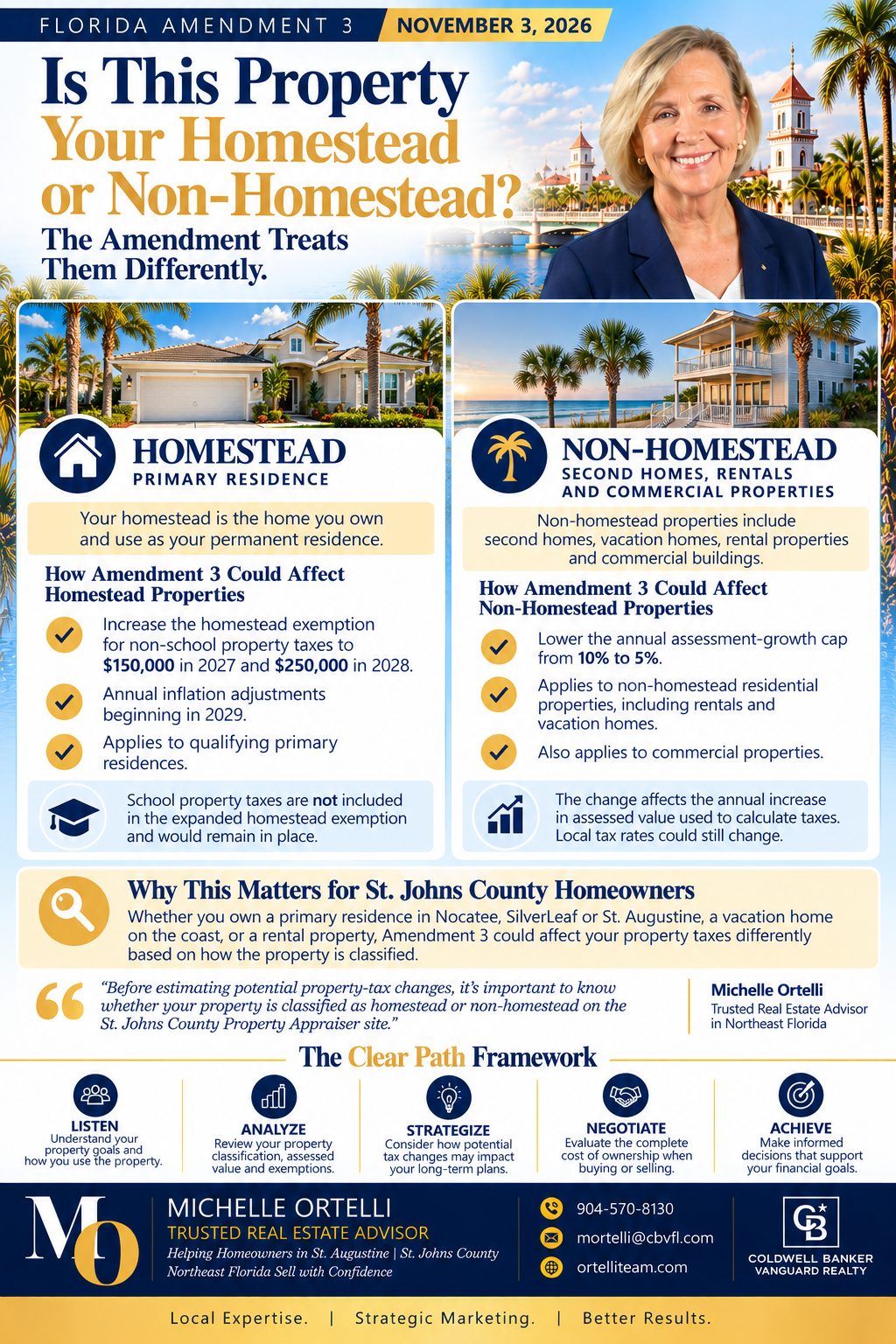
Amendment 3 proposes different property-tax changes for homestead and non-homestead properties.
For qualifying primary residences, the amendment would increase the homestead exemption on non-school property taxes.
For qualifying non-homestead properties, including second homes, vacation properties, rental homes, and commercial buildings, it would reduce the annual assessed-value growth cap from 10% to 5%.
These are two different tax benefits, and they should not be confused.
1. Homestead Properties: Your Primary Residence
A homestead is generally a property you own and use as your permanent residence, provided you meet Florida’s eligibility requirements.
If Amendment 3 passes, the proposed non-school homestead exemption would increase to:
2027: $150,000
2028: $250,000
Beginning in 2029, the exemption would receive annual inflation adjustments.
What does this mean?
Qualifying homeowners could see a reduction in the taxable value of their primary residences for non-school property taxes.
However, the actual savings would depend on their assessed value, existing exemptions, eligibility, and applicable tax rates.
The expanded exemption would not apply to school property taxes.
2. Non-Homestead Properties: Second Homes, Rentals, and Investments
If you own a vacation home in St. Augustine, a second home in Ponte Vedra Beach, or a rental property in St. Johns County, your property may be classified as non-homestead.
Under Amendment 3, the annual assessment-growth cap for qualifying non-homestead properties would decrease:
Current Cap: 10%
Proposed Cap: 5%
This means the assessed value used in calculating certain property taxes generally could not increase by more than 5% annually under the applicable limitation.
Important: This is a cap on annual assessed-value increases, not a guarantee that property taxes will increase by no more than 5%.
Tax rates and other factors could still change.
3. Why Does This Matter for Second-Home Owners?
St. Johns County attracts homeowners who purchase properties for vacations, retirement, seasonal use, or investment.
Some eventually decide to make Florida their permanent residence.
Others continue to maintain their primary residence in another state.
Your property’s classification matters because the proposed benefits are different.
Owning a home in Florida does not automatically qualify it for a homestead exemption.
Before estimating potential savings, verify how your property is currently classified.
You can review your property information through the St. Johns County Property Appraiser.
4. What About Homeowners Whose Listings Have Expired?
If your St. Johns County home was listed for sale but did not sell, Amendment 3 raises another question worth considering:
How might your property’s tax classification and carrying costs affect your plans?
For example:
- Is the property still your primary residence?
- Have you moved elsewhere while keeping the home?
- Is it now being used as a second home or rental?
- Have your insurance, taxes, HOA fees, or CDD assessments changed?
- Would selling, renting, or continuing to hold the property better support your goals?
An expired listing does not automatically change your homestead status.
However, changes in occupancy, ownership, or permanent-residence status can affect exemption eligibility.
Before changing how you use the property, consult the Property Appraiser or a qualified tax professional.
Michelle’s Expert Insight
“When working with homeowners in St. Johns County, especially those considering selling a second home or relisting an expired property, I encourage them to understand the complete financial picture.
Property taxes, insurance, maintenance, and community fees all influence the cost of holding a property.
Before estimating potential Amendment 3 savings, it’s important to know whether your property is classified as homestead or non-homestead.
That information can help you evaluate your options more confidently.”
The Clear Path Framework
LISTEN | Understand your property goals, whether you’re living in the home, using it seasonally, renting it, or considering selling.
ANALYZE | Review your property’s classification, assessed value, exemptions, current market conditions, and ownership costs.
STRATEGIZE | Consider how potential tax changes could affect your long-term plans for the property.
NEGOTIATE | Evaluate the complete financial picture when buying, selling, or repositioning a property.
ACHIEVE | Make informed decisions that support your financial goals and future plans.
The Bottom Line
Amendment 3 does not treat every Florida property the same way.
For qualifying homestead properties, the proposal focuses on increasing the non-school property-tax exemption.
For qualifying non-homestead properties, it focuses on limiting annual assessed-value increases.
And for homeowners considering whether to sell, rent, or retain a property, understanding the difference is an important part of evaluating the complete cost of ownership.
My Question for St. Johns County Property Owners
“Is your property your primary residence, a second home, or an investment property, and have you checked how it’s currently classified with the Property Appraiser?”
Michelle Ortelli | Trusted Real Estate Advisor in Northeast Florida | Specializing in
Helping Homeowners in St. Augustine | St. Johns County | Northeast Florida Sell with Confidence | Global Luxury | Residential | Relocation | Second Homes | Expired Listings
The Ortelli Team | Coldwell Banker Vanguard Realty
904-570-8130
mortelli@cbvfl.com
ortelliteam.com
Local Expertise. | Strategic Marketing. | Better Results.
Sources: Florida Department of State, Amendment 3 ballot information; Florida Revenue Estimating Conference fiscal impact analysis; St. Johns County Property Appraiser.
Educational Disclaimer: This post is provided for informational purposes only. It does not endorse or oppose Amendment 3 or recommend how anyone should vote. Actual property-tax impacts depend on eligibility, assessed values, applicable exemptions, tax rates, and implementation. Consult the St. Johns County Property Appraiser or a qualified tax professional regarding your specific circumstances.


